2024 in AI: What Stuck, What Fizzled, What Surprised Everyone
A reality check on 2024's AI landscape: copilots and RAG delivered real value, autonomous agents overpromised, and small language models quietly revolutionized enterprise deployments. Discover which trends actually mattered and what they mean for 2025's AI evolution beyond the hype.
12/23/20243 min read
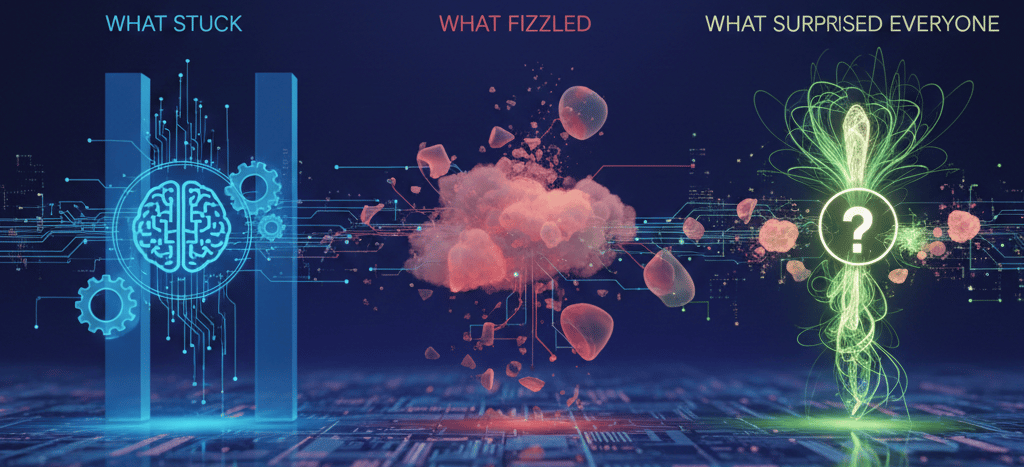
As we close the books on 2024, the artificial intelligence landscape looks radically different from what most predicted twelve months ago. While the hype machine churned out breathless predictions about fully autonomous everything, the reality proved far more nuanced—and in many ways, more interesting.
What Actually Landed
Copilots became the real deal. Microsoft installed Copilots alongside its Office 365 suite, while companies across industries deployed AI assistants for everything from industrial maintenance to security. Unlike chatbots that sit in isolation, these integrated helpers proved their value by embedding directly into existing workflows. The key wasn't revolutionary—it was incremental productivity gains that actually delivered ROI.
RAG emerged as the unsung hero. Retrieval-augmented generation became the framework enterprises embraced to make AI applications more accurate. By allowing models to fact-check themselves against external sources before responding, RAG solved the hallucination problem that plagued early deployments. It wasn't sexy, but it worked—and that mattered more than moonshots.
Open models came of age. Perhaps 2024's biggest surprise was how quickly open-source models caught up. Meta's Llama 3.1 achieved what Mark Zuckerberg called frontier-level status, while France's Mistral released models that matched or surpassed top-tier commercial systems. This wasn't just about benchmarks—it fundamentally shifted the economics of AI deployment. Companies could now customize powerful models for their specific needs without bleeding cash on API calls or surrendering proprietary data.
What Overpromised
Fully autonomous agents hit the reality wall. The excitement around AI agents that could independently handle complex tasks crashed into hard limitations. Cognition's Devin, announced as an autonomous software engineer, resolved only about fourteen percent of GitHub issues in benchmarking tests—impressive for AI, but nowhere near replacing human developers. General-purpose agents struggled with complex tasks, achieving only around fourteen percent success rates on end-to-end web-based challenges.
The pattern repeated across domains. Agent frameworks multiplied, funding poured in, but reliability remained the stumbling block—getting tasks right most of the time wasn't enough for enterprise deployment. Human oversight wasn't optional; it was mandatory.
The "AI everything" pitches wore thin. After rushing to slap AI onto every product, reality set in. Companies discovered they couldn't fully replace human decision-making with AI, finding that removing humans completely often created more problems than it solved. The gap between demo and production yawned wide. Many organizations found themselves stuck in the experimental phase, struggling with data quality issues, integration challenges, and the harsh economics of scaling AI workloads.
The Quiet Shifts That Matter
While headlines chased the latest foundation model release, three understated trends will shape AI's trajectory into 2025:
Small language models are winning by losing the parameter race. Research showed that over forty percent of enterprise AI deployments in 2024 were based on small language models, a dramatic shift from the previous year's fixation on massive general-purpose systems. These domain-specific models proved that specialized training on targeted datasets often outperforms throwing more parameters at general problems. Companies discovered that a lean, focused model that understood their specific business context delivered better results than a sprawling generalist.
Multi-agent systems replaced the single superintelligence dream. Rather than waiting for one AI to rule them all, enterprises began orchestrating teams of specialized agents working together. True multi-agent systems emerged in late 2024, with pilots demonstrating that distributing tasks among autonomous agents often outperformed single-model approaches. This architectural shift mirrors how human organizations actually work—specialized expertise coordinated toward common goals.
The hybrid approach triumphed over extremes. The loudest debates pitted open-source zealots against closed-model loyalists, but practitioners quietly adopted both. Organizations learned to use lightweight open models for routine tasks while reserving expensive frontier models for complex reasoning. Companies moved beyond simple chat implementations into sophisticated frameworks emphasizing multi-agent collaboration and more autonomous capabilities.
Looking Forward
The story of 2024 wasn't about AI replacing jobs en masse or achieving artificial general intelligence. It was about businesses learning what actually works. The winners weren't those who deployed the biggest models or moved fastest—they were those who thoughtfully integrated AI into workflows, managed expectations, and focused on measurable outcomes.
As we head into 2025, expect less hype, more substance. The focus will shift from proving AI can deliver value to systematically extracting that value at scale. The agents will get more reliable, the models more specialized, and the integration deeper. But the fundamental lesson of 2024 remains: in AI, as in most technology, the boring stuff that actually works beats the exciting stuff that doesn't—every single time.