Beyond Chat: Multimodal GPT-4V and the Future of 'Seeing' Models
GPT-4V brings image understanding to ChatGPT, enabling document analysis, chart interpretation, troubleshooting via screenshots, and accessibility applications. Practical use cases span professional workflows, education, and technical support. However, privacy risks around sensitive images, identification capabilities, and reliability limitations require careful consideration as multimodal AI becomes mainstream.
11/20/20234 min read
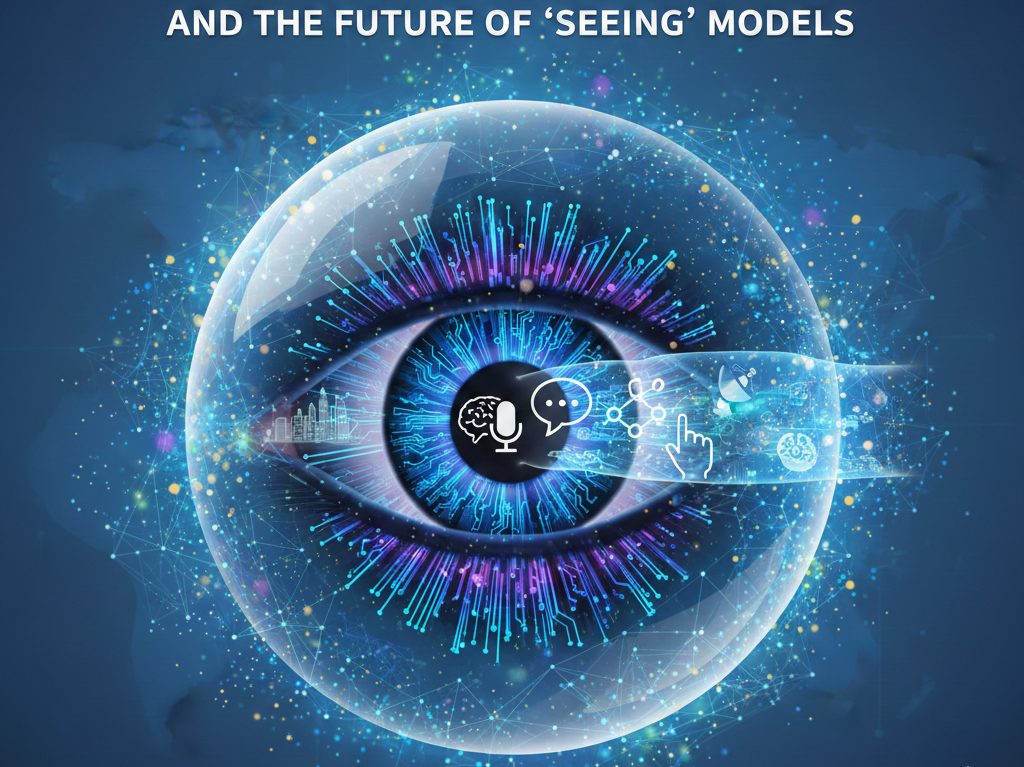
For most of 2023, GPT-4's visual capabilities existed as an open secret—demonstrated in OpenAI's March launch but unavailable to users. That changed in late September when GPT-4V (Vision) rolled out to ChatGPT Plus and Enterprise subscribers, transforming the experience from pure text conversation to genuine multimodal interaction. The implications extend far beyond novelty, suggesting how AI will increasingly understand and reason about visual information that dominates how humans actually work and communicate.
What GPT-4V Actually Does
GPT-4V accepts images as input alongside text, analyzing visual content with surprising sophistication. Unlike earlier image recognition systems that simply labeled objects, GPT-4V understands context, relationships, and visual reasoning that approach human-like interpretation.
The system can identify objects, people, and scenes, but more impressively, it grasps spatial relationships, reads and interprets text within images, analyzes charts and diagrams, and understands visual humor and cultural references. When shown a meme, it doesn't just identify the image elements—it understands the joke.
The technical achievement involves training the model to process visual and textual information through unified architecture rather than bolting separate vision and language models together. This integration enables reasoning that spans modalities: understanding how text labels relate to chart data, or how objects in a photo connect to a user's question about them.
Practical Use Cases Emerging
The most immediately useful applications center on professional workflows involving visual information:
Document analysis has become dramatically more accessible. Users can photograph receipts, invoices, or forms and ask GPT-4V to extract information, categorize expenses, or identify discrepancies. Legal professionals upload contracts and get summaries of key terms. Researchers photograph pages from books unavailable digitally and query the content conversationally.
The ability to process handwritten notes particularly impresses. Users photograph meeting notes and ask for structured summaries, action items, or clarification of unclear handwriting. This bridges the gap between analog note-taking and digital organization without manual transcription.
Chart and graph interpretation eliminates the barrier between visual data presentation and analysis. Users upload screenshots of complex visualizations and receive plain-language explanations of trends, outliers, and implications. For those who struggle with data visualization literacy, this democratizes access to quantitative information.
Technical troubleshooting has become conversational. Users screenshot error messages, photograph malfunctioning equipment, or share images of broken code and receive diagnosis and solutions. The model identifies error codes, recognizes UI elements, and understands visual context that purely text-based support cannot access.
Accessibility applications show particular promise. Visually impaired users can photograph their surroundings and receive detailed descriptions, navigate unfamiliar spaces by describing signage and obstacles, or understand visual content in documents and websites. While specialized accessibility tools exist, GPT-4V's generality makes it adaptable to countless situations those tools don't anticipate.
Educational support takes new forms. Students photograph math problems and receive step-by-step explanations. They share diagrams from textbooks and ask clarifying questions. Teachers upload student work and get feedback on common misunderstandings. The visual component makes AI tutoring applicable to subjects where visual representation is central.
The Limitations and Failure Modes
Despite impressive capabilities, GPT-4V has significant limitations. The system struggles with small text in images, sometimes misreading or missing details. Complex technical diagrams can confuse it, leading to incorrect interpretations presented with confident-sounding explanations.
Spatial reasoning, while improved, remains imperfect. Questions about precise measurements, counts of many similar objects, or subtle visual differences may produce unreliable answers. Users must verify outputs, particularly for high-stakes applications.
The model also sometimes hallucinates details not present in images, describing elements it expects to see rather than what's actually there. This tendency toward plausible confabulation makes it unsuitable for applications requiring perfect accuracy without verification.
Privacy and Safety Concerns
The ability to analyze images introduces novel risks that text-only systems avoided. GPT-4V can extract sensitive information from screenshots—passwords visible in browser windows, private messages, financial information, confidential documents. Users accidentally sharing sensitive visual information represents a significant privacy risk.
OpenAI has implemented refusals for certain image types. The model declines to identify people in photographs, even public figures, to protect privacy and prevent misuse for surveillance or stalking. It refuses to analyze images containing graphic violence, explicit content, or other potentially harmful material.
These refusals reflect difficult tradeoffs. Preventing person identification protects privacy but limits legitimate use cases like accessibility applications where identifying people in photos would help visually impaired users. The balance between capability and safety remains contested.
Deepfake and manipulated image detection presents another challenge. GPT-4V sometimes cannot reliably distinguish authentic from manipulated images, potentially amplifying misinformation if users treat its analysis as verification of image authenticity.
Medical image analysis raises particularly sensitive issues. Users naturally want to upload photos of symptoms or medical test results for interpretation, but AI providing medical diagnosis without appropriate disclaimers and safeguards could cause serious harm. OpenAI restricts medical analysis, but enforcement is imperfect.
The Multimodal Future
GPT-4V represents an initial step toward AI systems that understand information in the formats humans naturally use. We communicate through images, diagrams, videos, and spatial arrangements—not just text. AI systems limited to text processing miss most of how information actually exists and flows in real contexts.
The next evolution is already visible: models that generate images and analyze them, creating and reasoning about visual content in integrated workflows. Imagine describing a desired chart and having AI generate it, then iteratively refining based on visual feedback. Or architectural AI that can both interpret existing building photos and generate renovation visualizations.
Video understanding represents the logical next frontier. Models that can watch and comprehend video would enable applications from automated meeting summarization to educational content analysis to accessibility tools for video-heavy online content.
The integration of visual understanding into general-purpose AI fundamentally changes what these systems can do. Text-based AI required the world to translate visual information into words—a lossy, time-consuming process that excluded many types of information entirely. Multimodal AI can engage with information in its native format, making AI genuinely useful for the visual-heavy workflows that dominate professional and personal life.
GPT-4V isn't perfect, and significant challenges around privacy, safety, and reliability remain. But it represents a crucial transition from AI as sophisticated text processor to AI as genuine multimodal reasoner—seeing, understanding, and engaging with the visual world that humans navigate effortlessly and AI has historically found impenetrable.