DALL·E 3, Midjourney, and the New Era of Text-to-Image Reliability
DALL·E 3's ChatGPT integration and improved prompt fidelity make AI image generation genuinely reliable for the first time. While Midjourney maintains its aesthetic edge and Stable Diffusion offers customization, DALL·E 3 signals the technology's maturation from impressive experiment to dependable tool for designers, marketers, and everyday users.
10/16/20234 min read
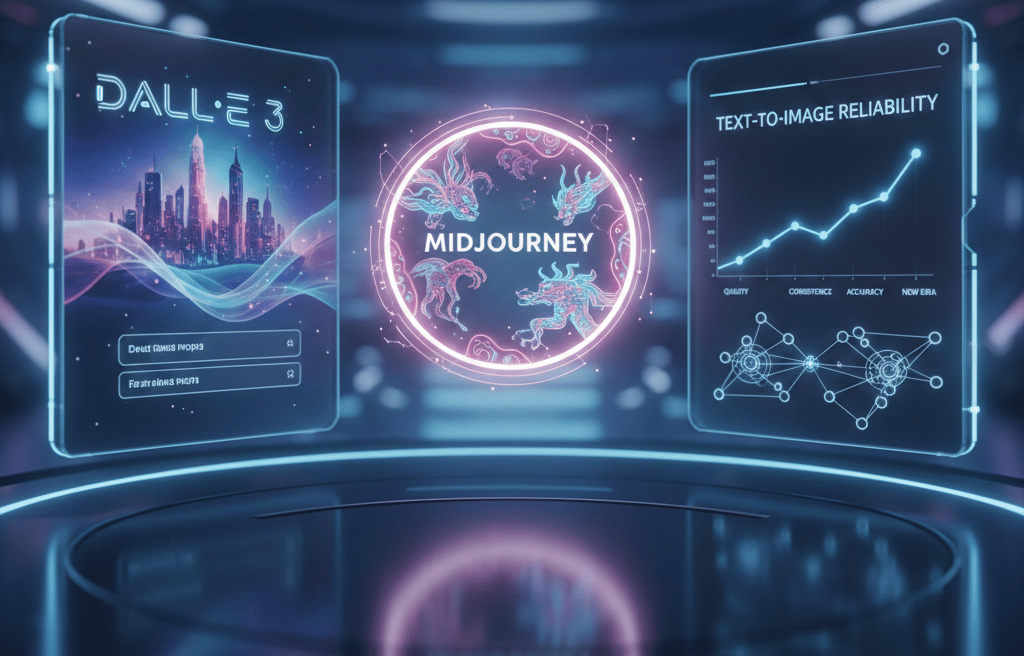
The release of DALL·E 3 this month marks a subtle but significant shift in the text-to-image AI landscape. Unlike the dramatic leap from DALL·E to DALL·E 2, this iteration focuses less on raw capability and more on something equally important: reliability. For the first time, AI image generation feels like a tool you can depend on rather than a creative lottery.
The Prompt Fidelity Problem
Anyone who's spent time with DALL·E 2, Midjourney, or Stable Diffusion knows the frustration. You craft a careful prompt—"a blue bird sitting on a red fence at sunset"—and receive a red bird on a blue fence at noon. You ask for three objects and get two. You specify positions and relationships only to have the model ignore half your instructions.
This wasn't just annoying; it was a fundamental barrier to professional adoption. Designers couldn't rely on these tools for client work when the output bore only passing resemblance to specifications. Marketers couldn't generate brand-consistent imagery when colors, compositions, and key elements were essentially random. The technology was impressive but unreliable.
DALL·E 3 directly confronts this limitation. OpenAI rebuilt the system with prompt adherence as a primary objective, and the results are immediately apparent. Complex prompts with multiple objects, specific arrangements, and detailed requirements now produce images that actually match what you asked for—most of the time.
The ChatGPT Integration Advantage
Perhaps DALL·E 3's most significant innovation isn't the image model itself but its integration with ChatGPT. Instead of wrestling with prompt engineering, users can simply describe what they want conversationally. ChatGPT interprets the request, asks clarifying questions if needed, and generates detailed prompts optimized for the image model.
This abstracts away the arcane art of prompt crafting that has characterized text-to-image AI. You no longer need to know that certain phrases trigger specific styles or that word order affects output. You describe your vision; ChatGPT translates it into model-speak.
The workflow becomes iterative and natural. Generate an image, request modifications ("make the lighting warmer," "move the subject left," "add a mountain in the background"), and ChatGPT handles the prompt adjustments. This conversational refinement process feels dramatically more intuitive than re-engineering complex prompts manually.
For professionals, this integration is transformative. A marketing manager can sketch out campaign concepts conversationally, iterate based on brand guidelines, and generate variations—all within a single chat interface. The barrier between idea and execution shrinks substantially.
Midjourney's Artistic Edge
Yet Midjourney remains the tool of choice for many creative professionals, and for good reason. While DALL·E 3 excels at prompt fidelity and ease of use, Midjourney V5.2 continues to produce images with distinctive aesthetic appeal.
Midjourney's outputs often possess a certain artistic quality—composition, lighting, and color harmony that feel intentionally crafted rather than technically generated. For concept artists, illustrators, and designers seeking inspiration or stylized imagery, Midjourney's aesthetic sensibility frequently outweighs DALL·E 3's technical precision.
The platform's community aspect also matters. Midjourney's Discord-based interface has fostered a vibrant ecosystem of creators sharing techniques, styles, and prompts. This collective knowledge base helps users achieve specific aesthetics and overcome limitations. DALL·E 3's integration into ChatGPT is more accessible but lacks this communal dimension.
Midjourney's parameter system—controlling aspects like stylization, chaos, and aspect ratio—offers granular control that appeals to power users. While less intuitive than ChatGPT's conversational interface, it provides precision that professionals often require.
Stable Diffusion's Open Alternative
Stable Diffusion occupies a different niche entirely. As an open-source model that runs locally, it appeals to users prioritizing control, privacy, and customization over convenience.
The ability to fine-tune Stable Diffusion on custom datasets means organizations can train models on proprietary imagery, maintaining brand consistency impossible with closed commercial services. For companies with extensive visual libraries or unique style requirements, this customization capability is invaluable.
Running locally also addresses data privacy concerns. Design firms handling confidential client work, or organizations in regulated industries, can generate images without sending prompts to external services. The trade-off is technical complexity—setting up and running Stable Diffusion requires comfort with command-line tools and model management.
Practical Implications for Different Users
For everyday users and small businesses, DALL·E 3's ChatGPT integration represents the lowest barrier to entry. Creating social media graphics, presentation images, or marketing materials becomes genuinely accessible without specialized knowledge.
For creative professionals and agencies, Midjourney often remains the superior choice for concepting and artistic work, while DALL·E 3's reliability makes it increasingly viable for production work requiring specific outputs.
For enterprise organizations with unique requirements, Stable Diffusion's customizability and local deployment options address concerns that commercial services cannot.
The Maturation of Text-to-Image AI
The broader trend these tools represent is the maturation of text-to-image AI from experimental technology to practical tool. We're moving beyond the "wow, AI made a picture" phase into "can AI generate the specific picture I need?"
DALL·E 3's focus on reliability over raw capability signals this shift. The limiting factor is no longer whether AI can generate impressive images—it clearly can—but whether it generates the right image consistently. Prompt fidelity, iterative refinement, and workflow integration now matter more than pure visual quality.
This reliability enables new use cases. Content creators can plan AI-generated imagery into production workflows rather than treating it as unpredictable inspiration. Marketing teams can brief AI tools like they brief designers, with reasonable confidence in results. The technology is becoming genuinely useful rather than merely impressive.
The competition between DALL·E 3, Midjourney, and Stable Diffusion ultimately benefits users. Each tool excels in different dimensions—ease of use, aesthetic quality, customization—pushing others to improve. We're entering an era where text-to-image AI isn't a single tool but an ecosystem of options, each optimized for different needs and workflows.
The images AI generates are finally starting to match the images we imagine. That might be the most significant development yet.