LLMs and Analytics, From Dashboards to Natural-Language BI
Large language models are transforming business intelligence from dashboard-dependent to conversational, enabling natural language queries and narrative explanations. While text-to-SQL and "chat with your warehouse" tools democratize data access, they also risk generating confident but incorrect insights. Critical data literacy remains essential to distinguish genuine patterns from persuasive hallucinations.
11/11/20243 min read
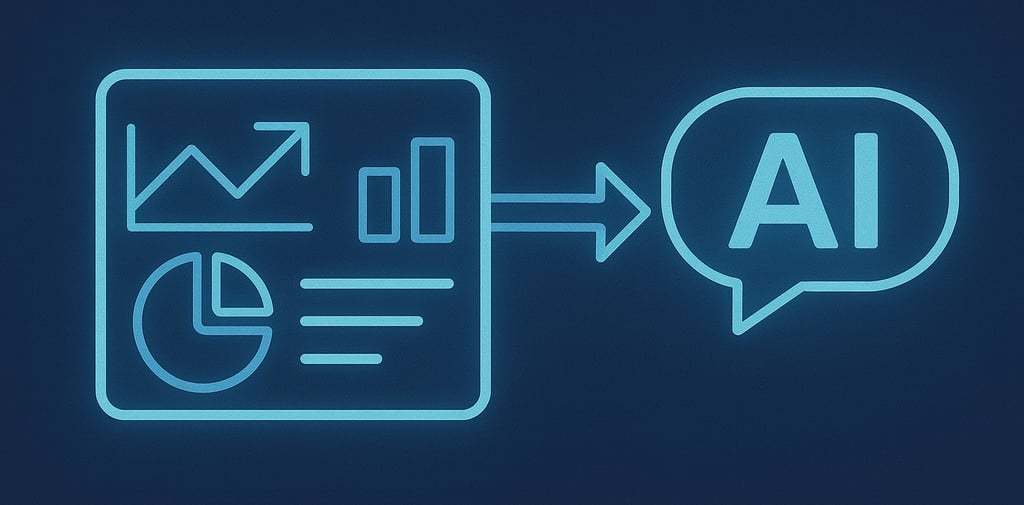
For decades, business intelligence has been trapped behind a wall of SQL queries, dashboard configurations, and specialized analytics tools. Data analysts have served as translators between business questions and data warehouses, turning "How did our Q3 sales perform?" into complex queries with joins, aggregations, and filters. But large language models are fundamentally reshaping this relationship, promising to democratize data access in ways we've only dreamed about.
The transformation is happening across three key fronts: automated query generation, narrative intelligence layers, and conversational analytics platforms. Each represents a significant leap from traditional BI, yet each also introduces new challenges around accuracy and interpretation.
Query Generation: Speaking Database
The most straightforward application of LLMs in analytics is translating natural language into SQL or other query languages. Tools like Thoughtspot, Mode's AI features, and various "text-to-SQL" solutions now let users ask questions in plain English and receive properly structured queries in return.
The sophistication here is remarkable. An LLM can understand that "show me customers who churned last quarter" needs to define churning (perhaps based on absence of transactions), identify the relevant time period, and join customer tables with transaction logs. It handles ambiguity reasonably well—inferring that "revenue" likely means summed transaction amounts unless context suggests otherwise.
However, this convenience masks a critical problem: users often can't verify if the generated query actually captures their intent. When a dashboard shows a 15% churn rate, did the LLM correctly define "active customer"? Did it account for seasonal customers? Did it deduplicate properly? Without reviewing the underlying SQL—which defeats the purpose of natural language interfaces—users are trusting a black box.
Narrative Explanations: Making Dashboards Talk
Perhaps more transformative than query generation is the LLM's ability to explain what data means. Modern BI platforms are integrating LLMs to generate narrative summaries of dashboard insights: "Sales increased 23% quarter-over-quarter, primarily driven by the Enterprise segment which grew 45%. However, SMB sales declined 8%, suggesting potential challenges in that market."
This narrative layer addresses one of traditional BI's biggest weaknesses—users drowning in visualizations without understanding the story. LLMs excel at pattern recognition across multiple charts, highlighting correlations and anomalies that might otherwise go unnoticed. They can contextualize numbers: a 5% revenue increase might be excellent in a declining market but disappointing during a boom.
The risk lies in hallucinated explanations. LLMs are pattern-matching machines that can confidently assert causal relationships where only correlations exist. "The marketing campaign caused the sales spike" sounds authoritative, but the LLM may simply have noticed temporal proximity. It doesn't understand confounding variables, seasonal effects, or statistical significance unless explicitly trained to consider them.
Chat With Your Warehouse
The most ambitious vision is fully conversational analytics—"chat with your warehouse" tools that let users explore data through iterative dialogue. Ask a question, receive an answer, then naturally follow up: "Now break that down by region" or "What about compared to last year?"
These platforms, emerging from startups and established players alike, promise to make everyone a data analyst. Product managers can investigate user behavior patterns without tickets to the data team. Sales leaders can slice revenue data interactively during meetings. Marketing can test hypotheses in real-time.
The technical achievements enabling this are impressive: maintaining context across conversation turns, understanding pronoun references ("show me those customers"), and handling follow-up refinements. Yet the fundamental challenge remains: LLMs don't understand your business logic. They don't know that "active user" has a specific definition your company agreed upon, or that certain data sources are more reliable than others.
Where Human Literacy Still Matters
This brings us to the paradox: as analytics becomes more accessible, data literacy becomes more critical, not less. When insights arrive wrapped in fluent prose with compelling visualizations, they're dangerously persuasive even when wrong.
Users need to think critically about:
Data quality: Are the underlying sources reliable and current?
Definitions: Does "customer" mean the same thing across all queries?
Statistical validity: Are sample sizes sufficient? Are comparisons meaningful?
Causation vs. correlation: Is the explained relationship real or spurious?
The democratization of analytics doesn't eliminate the need for expertise—it redistributes it. Rather than gatekeeping access, data professionals must become educators and auditors, helping others interpret LLM-generated insights correctly and building guardrails into systems.
LLMs are genuinely revolutionary for analytics, removing friction and making exploration intuitive. But they're tools that amplify both insight and error. The future of BI isn't replacing human judgment with AI—it's augmenting human curiosity with AI capabilities while maintaining healthy skepticism about pretty but potentially wrong insights.