LLMs in High-Stakes Fields: Drawing the Line Between Support and Decision
As AI enters healthcare, law, and finance, organizations face critical questions about accountability and transparency. This article explores how institutions are establishing boundaries between AI-assisted recommendations and human decisions, examining consent requirements, disclosure mandates, and governance frameworks that balance innovation with responsibility in high-stakes environments.
9/22/20253 min read
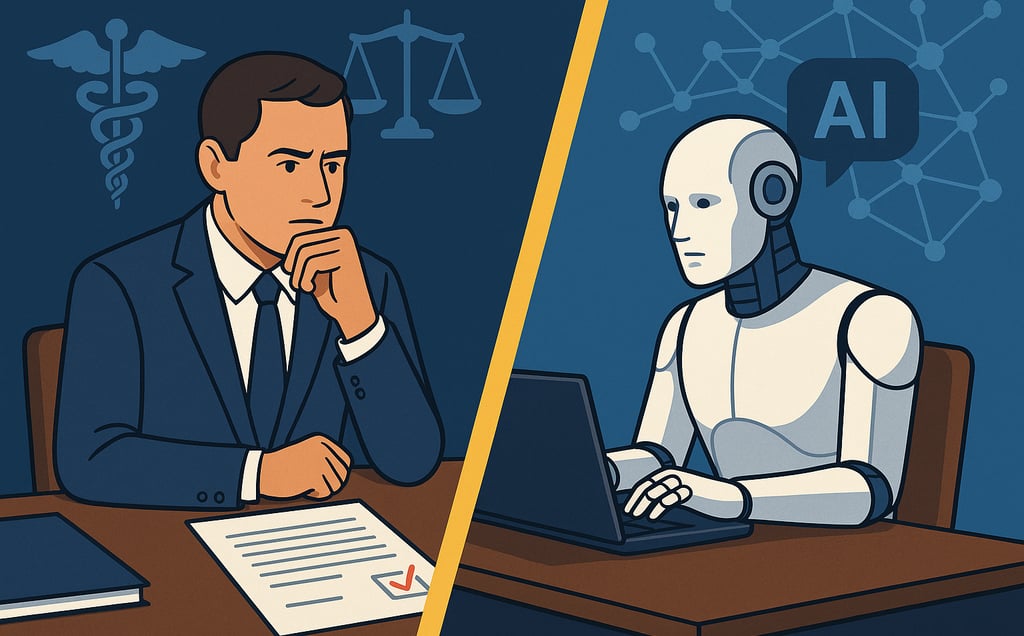

As large language models become increasingly sophisticated, they're making their way into domains where errors carry serious consequences. Healthcare providers consult AI systems for diagnostic suggestions. Financial institutions deploy algorithms to assess creditworthiness. Legal professionals use LLMs to draft contracts and predict case outcomes. The question keeping organizational leaders awake at night isn't whether to use this technology—it's where to draw the line between AI assistance and human decision-making.
The Human-in-the-Loop Mandate
The emerging consensus across high-stakes sectors is clear: AI should augment, not replace, human judgment. In healthcare, this principle has crystallized into what researchers describe as positioning LLMs as valuable adjuncts that improve diagnostic confidence and support decision-making, rather than autonomous decision-makers. A recent study on medication safety demonstrated this approach in action, finding that pharmacists working alongside AI systems achieved accuracy rates 1.5 times higher than pharmacists working alone when detecting errors that could cause serious harm.
This "co-pilot" model reflects a fundamental understanding that human expertise remains irreplaceable in complex decision-making. While AI excels at pattern recognition and processing vast amounts of data, it cannot replicate the contextual understanding, ethical reasoning, and emotional intelligence that professionals bring to high-stakes situations.
Transparency and Explainability Requirements
One of the most significant challenges in deploying LLMs in critical domains is the "black box" problem. When an AI system denies a loan application or flags a suspicious medical result, stakeholders need to understand why. The explainable AI movement has gained substantial momentum, with the market for transparency solutions expected to more than double by 2028.
In financial services, regulators are demanding clear explanations for AI-driven decisions. Credit scoring systems must now be able to demonstrate not just outcomes but the specific factors that influenced them—telling applicants, for instance, exactly how a higher income would have changed their loan approval. This requirement serves multiple purposes: building consumer trust, ensuring regulatory compliance, and preventing the perpetuation of historical biases embedded in training data.
The legal sector faces similar pressures. When judges increasingly rely on AI tools to analyze legal documents and identify relevant precedents, the risk of uncritically accepting AI-generated authority becomes acute. Recent incidents of AI "hallucinations" producing non-existent case citations have underscored the dangers of excessive reliance without verification.
Consent and Disclosure: The New Standard
Perhaps the most visible shift in AI governance is the proliferation of disclosure requirements. California's AB 2905 imposes $500 fines per violation for failing to disclose AI interactions. Texas's Responsible AI Governance Act establishes comprehensive disclosure requirements taking effect in 2026. The Colorado AI Act, considered landmark legislation, goes further by granting consumers the right to appeal AI-driven decisions and request human review.
These laws reflect a fundamental principle: people have the right to know when they're interacting with AI, particularly in consequential decisions affecting financial services, healthcare, employment, education, or access to essential services. The disclosure requirements extend beyond simple notification—they often include provisions for opting out of automated decision-making and accessing the data used in those decisions.
For organizations, this means reimagining user interfaces and customer interactions. Financial institutions must clearly indicate when algorithms are assessing risk or making credit decisions. Healthcare providers using AI for diagnostic support must obtain informed consent. Legal professionals employing AI research tools must disclose this to clients and verify all AI-generated content.
Defining Risk Tiers
Organizations are developing sophisticated frameworks to categorize AI applications by risk level. High-stakes decisions—loan approvals, employment terminations, medical diagnoses—require the highest level of human oversight, often case-by-case review. Medium-risk applications might use sampling-based review, while low-stakes decisions can operate with lighter supervision.
This tiered approach acknowledges that not all AI applications carry equal consequences. A chatbot handling routine customer service inquiries poses fundamentally different risks than an algorithm determining credit limits or recommending cancer treatments. The regulatory environment is evolving toward this "sliding scale" approach, where oversight intensity matches the potential impact on individuals' lives.
The Path Forward
As we navigate 2025, organizations in high-stakes fields are learning that successful AI integration requires more than technical excellence. It demands careful governance structures, transparent operation, and unwavering commitment to human accountability. The most successful implementations combine AI's speed and analytical power with human judgment, context, and ethical reasoning.
The boundary between AI support and AI decision-making isn't just a technical distinction—it's an ethical and legal imperative. Organizations that treat this boundary seriously, investing in explainability, obtaining proper consent, and maintaining meaningful human oversight, will not only comply with emerging regulations but also build the trust necessary for sustainable AI adoption.
The future of AI in high-stakes domains depends on getting this balance right. Technology should enhance human capability without diminishing human responsibility. As regulatory frameworks mature and best practices emerge, one principle remains constant: in decisions that significantly affect people's lives, humans must remain firmly in command.