The Battle for the AI Desktop: Microsoft, Google, and the New Productivity Stack
This article analyzes the competitive battle between Microsoft's Copilot and Google's Duet AI as both tech giants embed LLMs directly into productivity suites, examining real-world adoption patterns across email, documents, spreadsheets, and presentations. It explores how this integration is changing daily knowledge work while assessing enterprise adoption challenges including cost, change management, and quality concerns that temper the transformative potential of AI-augmented productivity tools.
9/18/20234 min read
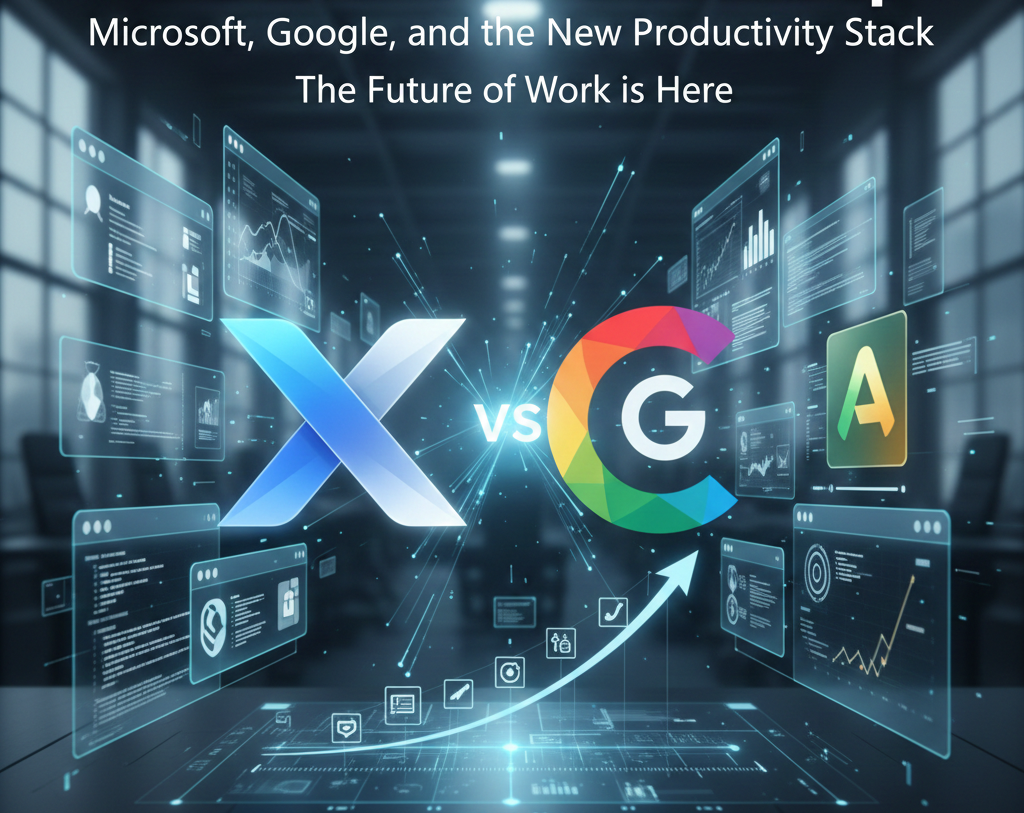
Microsoft's March announcement of Copilot for Microsoft 365 represented a strategic inflection point. Rather than treating GPT-4 as a standalone chatbot, Microsoft embedded it directly into Word, Excel, PowerPoint, Outlook, and Teams—the tools billions of knowledge workers use daily. The message was clear: AI wouldn't be a separate application you switch to; it would be ambient infrastructure woven into existing workflows.
Google responded in May with Duet AI for Workspace, embedding generative AI into Gmail, Docs, Sheets, and Meet. Six months into this battle for the AI-augmented desktop, the competitive dynamics and user adoption patterns reveal how productivity work is fundamentally changing.
Microsoft's Integration Strategy
Microsoft's Copilot appears as a sidebar in Office applications, accessible via a button or keyboard shortcut. The integration is contextually aware—Copilot in Word understands your document, in Excel sees your spreadsheet, in Outlook knows your email thread.
In Word, Copilot drafts content from prompts, rewrites sections for tone or length, summarizes long documents, and answers questions about document contents. A user might type "write an executive summary of this 20-page report" and receive a synthesized overview in seconds.
In Excel, Copilot analyzes data conversationally. "Show me which regions had declining sales last quarter" generates pivot tables and charts. "Explain why Q2 revenue missed forecast" examines data and highlights contributing factors. This democratizes data analysis for non-technical users who understand business questions but struggle with Excel formulas.
In PowerPoint, Copilot generates presentation outlines from prompts, converts Word documents into slide decks, and suggests visual layouts. "Create a presentation on our Q3 marketing strategy using last week's planning doc" produces a draft deck requiring refinement but saving hours of initial work.
In Outlook, Copilot summarizes long email threads, drafts responses matching your tone, and can process meeting recordings to generate action items and summaries. For executives drowning in email, this represents meaningful time savings.
The killer feature is cross-application awareness. Copilot can reference a spreadsheet while drafting a Word document, incorporate email threads into presentations, or analyze Teams meeting transcripts while scheduling follow-ups. This orchestration across the productivity suite creates value beyond any single application.
Microsoft announced $30/month per user pricing for Copilot—significant but positioned as worthwhile if it saves even an hour weekly. Enterprise adoption has been measured, with pilot programs common but broad rollouts limited by cost and caution.
Google's Competitive Response
Google's Duet AI offers similar capabilities across Workspace, though adoption and market visibility lag Microsoft's aggressive push. The functionality is comparable: drafting emails in Gmail, generating content in Docs, analyzing data in Sheets, and creating presentations in Slides.
Gmail's "Help me write" feature drafts emails from brief prompts. Users report it's particularly effective for routine communications—meeting requests, status updates, polite declines—though less capable for nuanced, relationship-sensitive correspondence.
Google Docs integration generates content, rewrites for tone, and provides inline suggestions. The "write about" feature expands bullet points into paragraphs, useful for outlining-to-draft workflows.
Google Sheets gained formula assistance and data analysis capabilities. Natural language queries like "calculate average sales by product category" generate appropriate formulas, lowering barriers for non-technical users.
Google's challenge is perception. Microsoft positioned Copilot as a premium, enterprise-focused offering with heavy marketing. Google's approach has been more cautious, creating impression that Duet AI is playing catch-up despite comparable technical capabilities.
Pricing and availability have also differed. Microsoft moved quickly to broad enterprise availability with clear pricing. Google's rollout has been more gradual, creating momentum advantages for Microsoft among enterprises evaluating options.
The User Experience Reality
Early adopters report mixed experiences. The productivity gains are real but uneven across use cases and user sophistication.
Email and communication see immediate benefits. Drafting routine emails, summarizing threads, and scheduling coordination happen faster. Users consistently report time savings here, though some note that AI-generated emails have a detectable sameness of tone that may erode over time.
Content creation shows variable value. For first drafts and brainstorming, AI assistance accelerates work significantly. For final, polished content requiring nuance, creativity, or deep subject matter expertise, AI provides scaffolding but not finished products. Writers describe it as "upgrading from blank page to rough draft"—valuable but not transformative.
Data analysis democratization is perhaps most impactful. Non-technical product managers, marketers, and executives can now explore data conversationally, asking questions without needing to learn advanced Excel or SQL. This shifts data from specialized bottleneck to accessible resource.
Presentation creation receives mixed reviews. AI generates acceptable outlines and layouts but lacks the design sensibility for compelling presentations. Users appreciate the time saved on structure while still investing significantly in visual refinement.
The common pattern: AI excels at routine, well-defined tasks while humans remain essential for judgment, creativity, and relationship-sensitive work. The tools compress time on the former, freeing capacity for the latter.
The Adoption Challenges
Despite capabilities, adoption faces hurdles. Cost sensitivity limits deployment at $30/user/month. Enterprises calculate ROI carefully, often piloting with select teams rather than company-wide rollout.
Change management proves significant. Workers accustomed to existing workflows must learn new interaction patterns. Keyboard shortcuts, sidebar interfaces, and conversational commands require adjustment and training.
Quality concerns create hesitation. AI-generated content requires review. Hallucinations, inappropriate tone, or factual errors mean users can't blindly trust outputs. Organizations fear that employees might send AI-drafted content without adequate verification.
Privacy and security questions mirror broader enterprise AI concerns. What data is sent to Microsoft or Google? How is it used? Can sensitive information leak? Enterprise agreements address these contractually, but cultural comfort lags legal agreements.
Competitive dynamics create strategic questions. Committing deeply to Microsoft's AI ecosystem increases switching costs and platform lock-in. Some enterprises hesitate, preferring to wait as the market matures and alternatives emerge.
What This Means for Productivity
The embedded AI productivity stack represents more than incremental improvement. It's a fundamental shift in how knowledge work happens. Tasks that consumed hours—drafting documents, analyzing data, creating presentations—compress to minutes. The time savings accumulate.
But this creates second-order effects. If everyone produces more content faster, does the volume of email, docs, and presentations simply increase, offsetting efficiency gains? Early evidence suggests yes—teams report more communication, not less. The limiting factor shifts from production to consumption and decision-making.
The competitive battle between Microsoft and Google will shape enterprise infrastructure for the next decade. Microsoft's aggressive integration and first-mover advantage has created meaningful lead. Google's technical capabilities remain strong, but market perception and enterprise momentum favor Microsoft currently.
For knowledge workers, the question isn't whether AI will embed in productivity tools—that's inevitable. The question is how to adapt workflows, develop new skills, and maintain quality as tools evolve. The AI desktop is here. Learning to work with it effectively is the productivity challenge of 2023 and beyond.