Three Plausible Futures for Work in the Age of AI
Explore three distinct scenarios for work's AI-transformed future: an augmentation-heavy economy where humans and AI collaborate, an automation wave that restructures employment around algorithms, and a regulation-constrained landscape that prioritises compliance. Discover key signals to monitor and strategic bets for navigating whichever pathway emerges.
11/24/20253 min read
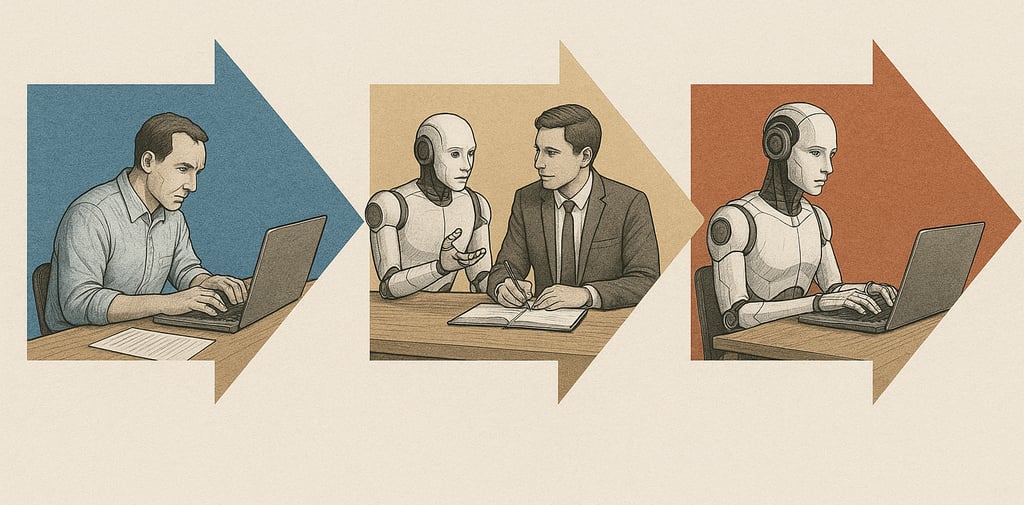
The landscape of work stands at a critical juncture. As artificial intelligence reshapes every corner of the knowledge economy, the future remains genuinely uncertain. Rather than make bold predictions, we can map three distinct pathways that organisations and workers might find themselves navigating—each with different implications for how we'll earn our living in the coming decade.
Scenario One: The Augmentation Economy
In this future, AI becomes the ultimate productivity multiplier. Workers across industries leverage AI assistants to amplify their capabilities rather than replace them. Recent research suggests this pathway is already materialising—employees currently save an average of 3.5 hours weekly through AI automation, while workers possessing AI skills command wage premiums that have risen from 25% to 43% in just one year.
The augmentation economy thrives on human-machine partnership. Marketing professionals craft strategy while AI handles data analysis. Software developers focus on architecture while AI generates boilerplate code. Healthcare workers provide empathy and judgment while AI processes diagnostic imaging. In this scenario, skills evolution accelerates dramatically. The demand for AI-related competencies increases by 30% annually, with workers in AI-exposed roles experiencing skill requirements that shift twice as fast as traditional positions.
Signals to watch: Sustained wage growth for AI-skilled workers across sectors; proliferation of no-code platforms enabling broader participation; upskilling investments by major employers.
Strategic bets for individuals: Develop prompt engineering capabilities; focus on judgment and decision-making skills that complement AI; build expertise in translating between technical and business domains.
Strategic bets for organisations: Invest in comprehensive AI literacy programmes; redesign workflows around human-AI collaboration; measure productivity gains from augmentation rather than headcount reduction.
Scenario Two: The Automation Wave
This pathway sees organisations prioritising cost reduction through aggressive automation. Current projections indicate that 30% of jobs could be fully automated by 2030, with 60% experiencing significant task-level changes. The automation wave doesn't eliminate knowledge work entirely—it fundamentally restructures it around a smaller core of highly skilled professionals supported by sophisticated AI systems.
Industries adopt hyperautomation strategies, combining AI, machine learning, and robotic process automation to transform entire operational ecosystems. Customer service teams shrink dramatically as AI handles approximately 85% of interactions. Financial analysis, legal document review, and medical coding become predominantly algorithmic functions. The workforce bifurcates: a premium tier of AI managers and strategists commanding higher wages, and a larger service sector focused on inherently human tasks like personal care and skilled trades.
Signals to watch: Declining job postings in administrative and clerical roles; rising investment in robotic process automation; corporate announcements emphasising efficiency over growth.
Strategic bets for individuals: Pivot toward roles requiring physical presence or deep human interaction; develop expertise in AI system oversight and troubleshooting; pursue opportunities in growing sectors like healthcare and construction.
Strategic bets for organisations: Prepare comprehensive workforce transition plans; invest in reskilling programmes that move employees into emerging roles; monitor public sentiment around automation carefully to maintain social license.
Scenario Three: The Regulated Frontier
In this future, aggressive government intervention reshapes how AI can be deployed in employment contexts. Following Colorado's pioneering legislation, multiple states have enacted comprehensive frameworks requiring bias audits, impact assessments, and extensive transparency measures. By 2026, employers operating in states like Colorado, Illinois, New York, and California must navigate a complex patchwork of requirements around algorithmic discrimination, notification obligations, and human oversight mandates.
Compliance costs rise substantially. Organisations spend heavily on third-party audits, documentation systems, and legal review. Some AI applications become economically unviable under the regulatory burden. Innovation shifts toward jurisdictions with lighter-touch frameworks, creating geographic disparities in AI adoption. The regulation-constrained scenario paradoxically accelerates AI development in some areas while freezing it in others, as companies seek tools explicitly designed for regulatory compliance.
Signals to watch: Increased litigation around AI hiring tools; state-level regulatory expansion beyond employment into broader AI governance; formation of compliance technology industry.
Strategic bets for individuals: Develop expertise in AI governance and compliance; position yourself in jurisdictions with clear regulatory frameworks; understand your rights around algorithmic decision-making.
Strategic bets for organisations: Build robust documentation practices from the outset; engage proactively with regulators; consider geographic strategy in AI deployment; invest in explainable AI systems.
Preparing for Uncertainty
The reality will likely blend elements of all three scenarios, varying by industry, geography, and organisational culture. Technology companies might inhabit the augmentation economy while manufacturing embraces automation and healthcare navigates increasing regulation.
The wisest approach involves preparing for multiple futures simultaneously. Individuals should cultivate uniquely human capabilities—creativity, emotional intelligence, complex judgment—while building comfort with AI tools. Organisations must balance efficiency gains against workforce stability, innovation against compliance, and short-term optimisation against long-term adaptability.
The next five years will reveal which pathway becomes dominant. What remains certain is that passivity represents the highest-risk strategy of all.