What Exactly Is ChatGPT? A Plain-Language Guide for Non-Technical Readers
This article gives a simple, non-technical introduction to ChatGPT, explaining what it is, how it works under the hood, and why it suddenly became so popular. It describes ChatGPT as an AI chatbot built on a large language model that predicts the next word in a sentence, fine-tuned with human feedback to follow instructions and hold natural conversations. The piece highlights how anyone can use it for writing, learning, coding help, and brainstorming, while also warning that it can be confidently wrong and should be treated as a helpful assistant rather than a source of absolute truth.
12/19/20222 min read

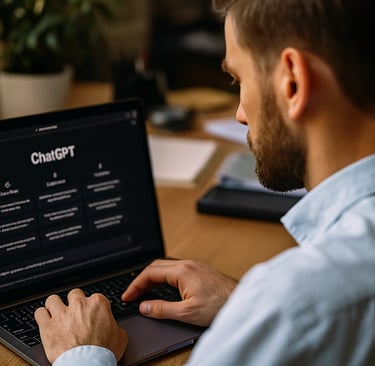
If your social media feed has suddenly filled up with screenshots of an AI “writing essays” or “explaining code,” you’ve already met the new star of the internet: ChatGPT. Launched by OpenAI as a free research preview, it’s a chatbot you can talk to like a person—and it replies in full sentences, paragraphs, and even stories. But what is ChatGPT really, and why is everyone talking about it?
So… What Is ChatGPT?
ChatGPT is an AI-powered chatbot. You type something in—like a question, a request, or even a half-finished sentence—and it responds in natural language. You can ask it to:
Explain a concept (e.g., “Explain inflation like I’m 10 years old”)
Draft text (emails, essays, LinkedIn posts, poems)
Help with code (debug, explain, or generate snippets)
Brainstorm ideas (business names, content topics, gift ideas)
Think of it as a very advanced autocomplete that can hold a conversation instead of just finishing your sentence.
How Does It Work Under the Hood (Without the Jargon)?
Underneath the chat interface, ChatGPT is built on a large language model. Here’s a simple way to think about it:
It reads a lot
Before you ever talk to it, the model has been trained on huge amounts of text from the internet, books, and other sources. It doesn’t “remember” specific pages like a person, but it has absorbed patterns of how language is used.It predicts the next word
At its core, ChatGPT is a very sophisticated “next word predictor.” Given some text (your question), it tries to guess the most likely next word, then the next, and the next—very quickly. With enough training, those guesses start to look like reasoning, explanation, and conversation.It’s fine-tuned to follow instructions
On top of the basic model, OpenAI trained ChatGPT using human feedback. People rated and compared different answers, and the model learned which responses are more helpful, polite, and safe. That’s why it can follow instructions like “answer in bullet points” or “explain in simple terms.”
It’s important to know: ChatGPT doesn’t “think” or “understand” like a human. It doesn’t know if something is true; it just generates text that looks right based on patterns it has seen. That’s why it can sometimes be confidently wrong.
Why Is Everyone Talking About It?
A few reasons:
It feels accessible – You don’t need to be a programmer. You just type a message like you would in WhatsApp or Messenger.
It’s surprisingly good at many things – Writing, explaining, summarizing, brainstorming, coding—most tools do one thing. ChatGPT feels like it can do dozens.
It feels conversational – It remembers what you said earlier in the chat (within a limit), so you can ask follow-up questions instead of starting from scratch each time.
It changes what’s possible for “everyday people” – Students, freelancers, small business owners, and non-technical professionals are suddenly using AI as a writing assistant, tutor, or idea partner.
For many people, this is the first time AI feels like something they can personally use, not just read about in the news.
What Should You Keep in Mind?
ChatGPT is impressive—but not magical. It can:
Make mistakes and “hallucinate” facts
Reflect biases in its training data
Sound confident even when wrong
So it’s best treated as a smart assistant, not an unquestionable authority. Use it to draft, explore, and speed up your work—but still apply your own judgment.
In short, ChatGPT is a powerful step toward a future where we talk to computers in plain language instead of clicking buttons and filling forms. It doesn’t understand the world like we do—but it’s already changing how millions of people learn, write, and create.